
Modern enterprises operate on complex ERP ecosystems. Platforms such as SAP, Oracle, Workday, NetSuite, and Microsoft D365 power finance, procurement, HR, supply chain, and operational decision-making. These systems are the digital backbone of the enterprise.
But as ERP environments expand, so does compliance risk.
Without structured governance, organizations face increasing exposure to segregation of duties (SoD) conflicts, excessive access privileges, sensitive transaction abuse, and regulatory penalties. What was once manageable through periodic reviews has become too dynamic, too complex, and too risky.
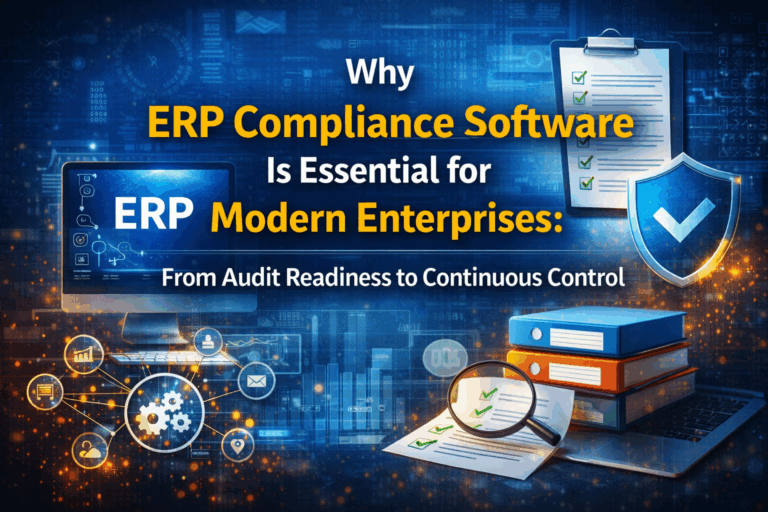
This is why ERP compliance software has evolved from a helpful tool into a strategic necessity, not only to prepare for audits, but to enable continuous control across the enterprise.
The Growing Complexity of ERP Compliance
Regulatory scrutiny continues to intensify across industries and geographies. Organizations must comply with frameworks such as SOX, GDPR, HIPAA, and other industry-specific mandates. Each requires demonstrable internal controls, disciplined user access management, and traceable financial integrity.
At the same time, ERP environments are becoming more complex due to:
- Cloud migrations and hybrid architectures
- Increased customization and integrations
- Expanding global user bases
- Frequent role changes and temporary access
- Third-party and contractor access
Manual compliance processes, spreadsheets, ad-hoc reviews, and annual audit preparations, cannot scale to this level of change. They are reactive by nature and leave gaps between review cycles.
ERP compliance software introduces automation, structure, and continuous oversight into environments that are constantly evolving.
What Is ERP Compliance Software?
ERP compliance software is a specialized governance solution designed to monitor, enforce, and document internal controls within ERP systems. Rather than relying on periodic checks, it provides ongoing visibility into access risk and compliance posture.
Core capabilities typically include:
- Segregation of Duties (SoD) monitoring
- Sensitive access detection
- Role and authorization analysis
- Configuration and transaction monitoring
- Continuous compliance reporting
The key shift is moving from audit-season readiness to year-round control assurance.
From Audit Readiness to Continuous Control
Historically, compliance was event-driven. Organizations prepared for audits once or twice per year, often under tight timelines and significant pressure. This reactive model led to manual evidence gathering, operational disruption, and elevated audit risk.
Modern ERP compliance software replaces that cycle with continuous control. Users, roles, and permissions are scanned automatically. SoD conflicts are identified in real time. Sensitive transactions are monitored continuously. Audit trails are maintained without manual intervention.
Instead of scrambling to prepare for audits, organizations remain audit-ready at all times.
The Business Value of ERP Compliance Software
While compliance is often viewed as defensive, the impact of ERP compliance software extends far beyond regulatory alignment.
It reduces risk exposure by identifying violations early, before they escalate into material weaknesses or public findings. It improves operational efficiency by eliminating manual data collection and repetitive reviews. It strengthens security governance by enforcing least-privilege access principles. It accelerates audits by providing standardized reporting and defensible documentation.
Most importantly, it scales with the organization, across systems, geographies, and business units.
Why Modern Enterprises Cannot Ignore It
Digital transformation has expanded the ERP attack surface dramatically. Cloud ERP adoption, remote work environments, increased system integrations, and third-party access all introduce new risk vectors.
Without automated compliance monitoring, enterprises operate with blind spots. ERP compliance software acts as the central nervous system of governance, delivering real-time visibility into who has access to what, where conflicts exist, and where controls may be weakening.
Continuous visibility is no longer optional in a regulated, cloud-driven economy.
Strengthening ERP Compliance with 1TRC
1TRC – 1Trooper Risk Cloud delivers continuous ERP compliance monitoring across:
- SAP
- Oracle Cloud & EBS
- Workday
- NetSuite
- Microsoft D365
With client-based licensing starting around $18K per year, organizations can automate SoD and sensitive access controls, replace manual spreadsheets, reduce audit pressure, and achieve measurable ROI.
Because ERP compliance should be proactive, not reactive.
Building a Compliance-Driven Enterprise
Technology alone does not create governance maturity. Leading enterprises combine ERP compliance software with clearly defined access policies, structured role design standards, executive accountability, and ongoing monitoring.
When compliance is embedded into daily operations rather than treated as a periodic exercise, risk decreases and organizational confidence increases.
Conclusion
ERP compliance software is no longer a “nice-to-have.” It is a strategic requirement for modern enterprises operating in highly regulated environments.
By enabling continuous control, strengthening audit readiness, and improving access governance, ERP compliance software protects financial integrity and organizational reputation. Enterprises that transition from reactive audits to continuous monitoring gain not only compliance stability, but competitive advantage.
#ERPCompliance #GRCSoftware #AuditReadiness #ContinuousControl #RiskManagement #EnterpriseSecurity #ITCompliance #SAPSecurity #OracleERP #1trooper