

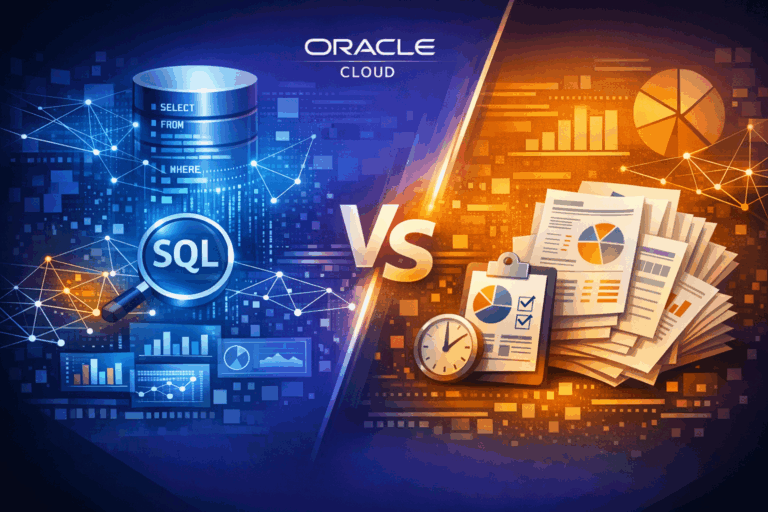
Enterprise decision-making depends on accurate, timely, and actionable insights. Oracle Cloud ERP provides multiple ways to access data, most commonly through traditional reports and SQL queries. While both approaches play important roles, understanding their strategic impact is essential. The comparison between Oracle Cloud ERP SQL Query and traditional reporting highlights how enterprises can redefine business intelligence in the digital era.
Traditional ERP reports deliver standardized, structured outputs designed for recurring operational and financial needs. They are easy to consume, well-governed, and effective for routine reporting such as month-end close, compliance summaries, and management dashboards. However, traditional reports are often limited in flexibility, making it difficult to answer complex or evolving business questions without additional customization or IT involvement.
SQL queries unlock a deeper layer of ERP intelligence. With a powerful SQL Query for Oracle Cloud ERP, organizations can analyze cross-functional data, explore transactional detail, detect anomalies, and generate insights that go beyond predefined dashboards. SQL-driven analytics are particularly valuable for compliance validation, risk assessment, license optimization, and advanced operational analysis where precision and flexibility matter most.
Despite these advantages, SQL querying also introduces challenges. Writing and maintaining complex queries requires technical expertise. Manual query processes can create delays, inconsistencies, and fragmented insights across teams. Without centralized governance and automation, SQL-based analytics can become difficult to scale and manage effectively.
The future of enterprise analytics lies in combining the strengths of both approaches. By integrating SQL intelligence with automated monitoring and standardized reporting frameworks, organizations can achieve a unified, real-time intelligence ecosystem, one that delivers both flexibility and consistency.
1Trooper bridges this gap by enabling enterprises to transform Oracle Cloud ERP data into continuous, governed intelligence. Through automation and analytics, organizations can leverage SQL-driven insights while maintaining enterprise-wide consistency, control, and auditability.
Ultimately, the discussion around Oracle Cloud ERP SQL Query vs. traditional reporting is not about choosing one over the other. It’s about building a strategic analytics framework that provides visibility when it’s needed, control where it matters, and agility as the business evolves.
In a rapidly changing enterprise landscape, organizations that modernize their ERP analytics capabilities gain a decisive advantage in performance, compliance, and innovation.