All About SAP: A Complete Guide to Enterprise Resource Planning
What Is SAP?
SAP (Systems, Applications, and Products in Data Processing) is one of the world’s leading providers of enterprise software for business process management. SAP develops intelligent solutions that enable efficient data processing, seamless information flow, and integrated operations across organizations of all sizes.
As one of the pioneers of standardized enterprise software, SAP continues to lead the market with innovative Enterprise Resource Planning (ERP) solutions that support digital transformation, operational efficiency, and sustainable growth.
SAP Overview
SAP initially introduced SAP R/2 and later SAP R/3, establishing the global standard for ERP systems. These solutions transformed how organizations managed finance, logistics, manufacturing, and human resources on a unified platform.
With the introduction of SAP S/4HANA, ERP entered a new era. Built on in-memory computing, SAP S/4HANA enables organizations to process massive volumes of data in real time while leveraging advanced technologies such as Artificial Intelligence (AI) and Machine Learning (ML).
Today, SAP delivers:
- An intelligent, integrated digital platform
- End-to-end business process connectivity
- Real-time analytics and insights
- Cloud-based and on-premises deployment options
SAP currently supports 230+ million cloud users and offers 100+ solutions covering virtually every business function.
Uses of SAP Software
Traditional business models often rely on decentralized data systems, where each department maintains its own database. This approach creates challenges such as:
- Limited data visibility across departments
- Data duplication and inconsistencies
- Increased IT storage and maintenance costs
- Higher risk of operational and reporting errors
SAP overcomes these challenges by centralizing enterprise data on a single platform. This unified approach enables organizations to manage complex business processes efficiently while providing employees across departments with real-time access to accurate information.
With SAP software, businesses can:
- Accelerate workflows and decision-making
- Improve productivity and operational efficiency
- Enhance collaboration across departments
- Deliver better customer experiences
- Achieve measurable business growth and profitability
What Does SAP Do?
SAP software solutions empower organizations of all sizes and industries to operate more efficiently, adapt quickly to change, and grow sustainably. SAP enables businesses to map, design, and optimize their processes using standardized applications, platforms, and industry-specific solutions.
SAP collects and processes enterprise data on a single platform, covering the entire value chain from:
- Raw material procurement
- Manufacturing and operations
- Supply chain and logistics
- Sales, service, and customer experience
Organizations can deploy SAP solutions either on-premises or in the cloud, providing flexibility while maintaining full control over business operations.
Business Intelligence and Predictive Capabilities
Beyond transactional processing, SAP enables advanced analytics and forecasting. Organizations can use SAP solutions to:
- Predict equipment maintenance needs
- Forecast revenue growth and demand trends
- Analyze operational performance in real time
- Connect customer feedback with business processes
By linking operational data with customer experience insights, SAP helps organizations understand customer behavior, respond proactively, and make data-driven decisions that drive long-term success.
Conclusion
SAP is more than an ERP system, it is a comprehensive digital business platform that connects people, processes, and data. By enabling real-time insights, intelligent automation, and end-to-end process integration, SAP helps organizations optimize operations, enhance customer engagement, and remain competitive in a rapidly evolving digital economy.
At 1TRS, we help enterprises unlock the full potential of SAP by aligning technology with business strategy, governance, and performance optimization.
- #1Trooper
- Cloud ERP Solutions
- Enterprise Resource Planning
- SAP business process management
- SAP ERP solutions
- SAP S/4HANA
- SAP software
- What is SAP
Related articles
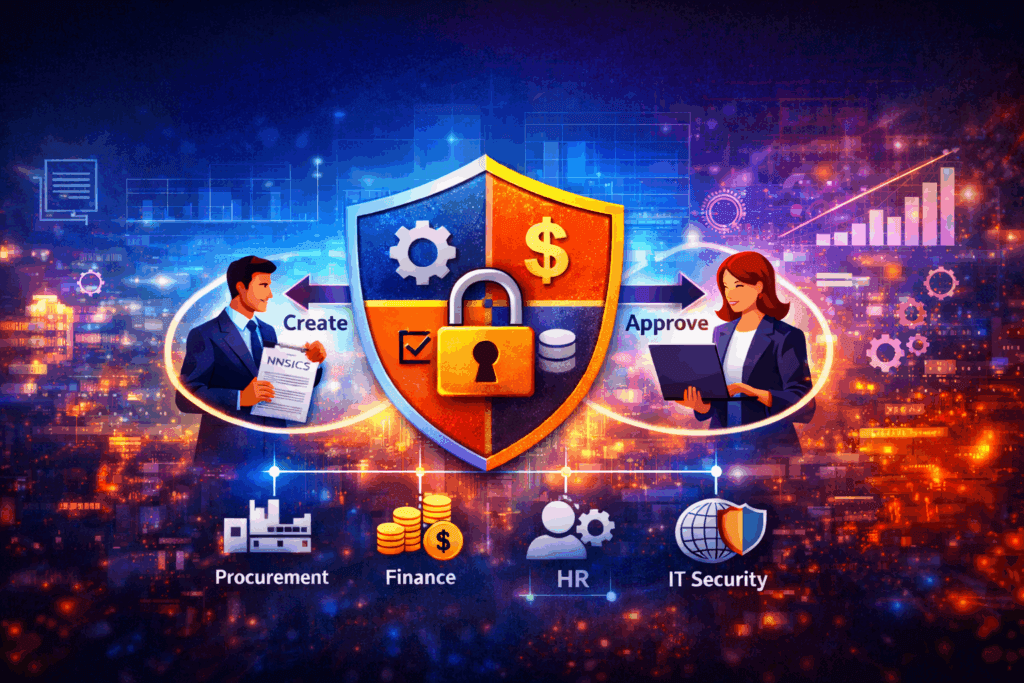
Segregation of Duties: The Most Critical and Complex Control in Modern ERP
In today’s digital-first enterprises, ERP systems sit at the core of business operations, supporting finance, procurement, HR, supply chain, and mission-critical decision-making. While these platforms enable scale and efficiency, they also introduce a significant risk when access is not governed correctly: conflicting or excessive user privileges. This is where Segregation of Duties (SoD) becomes not just important, but essential. Why…
How ERP Role-Based Access Control Aligns Functional Efficiency and Security?
As enterprises scale and digitize operations, ERP environments become increasingly complex, supporting multiple departments, geographies, partners, integrations, and automation. While this complexity enables growth, it also introduces significant access and security risk. The challenge for modern organizations is clear: how do you maintain operational efficiency without compromising security? The answer lies in a well-designed ERP role-based access control (RBAC) tool. Understanding…
Identity Governance for ERP Isn’t Complete Without Segregation of Duties
As enterprises continue to modernize their ERP environments, identity has become the new security perimeter. Users, roles, service accounts, bots, and third-party integrations now access critical ERP functions across finance, HR, procurement, and supply chain operations. While many organizations invest heavily in access controls and role management, identity governance for ERP remains incomplete without one foundational control: Segregation of Duties…