

Segregation of Duties (SoD) is a foundational element of effective internal control systems. It is designed to ensure that no single individual has complete authority over all stages of a transaction, thereby reducing the risk of fraud, errors, and unauthorized activities.
SoD has been widely adopted across industries such as finance, healthcare, and government, where regulatory compliance and risk management are critical. In recent years, organizations have increasingly turned to technology-driven SoD solutions to enhance control effectiveness and operational efficiency.
The Role of Technology in Modern SoD
Traditionally, SoD was implemented by assigning different responsibilities to different individuals. While effective in theory, this approach becomes difficult to manage in large, dynamic organizations.
Technology enables organizations to establish precise, flexible, and scalable SoD controls by:
- Defining access based on roles and job functions
- Eliminating manual dependency on individual task assignments
- Adapting controls quickly as business processes evolve
This shift significantly improves the consistency and sustainability of SoD enforcement.
Real-Time Monitoring and Continuous Risk Detection
A critical aspect of modern SoD is continuous, real-time monitoring of access and transactions. Instead of relying solely on periodic audits or manual reviews, organizations can now:
- Detect access conflicts as they occur
- Identify suspicious activities in real time
- Respond immediately to potential fraud or errors
By implementing real-time monitoring and analytics, organizations minimize the impact of control violations and strengthen their overall risk posture.
Advanced Analytics, Data Insights, and Visualization
Modern SoD solutions also incorporate data analysis and visualization capabilities, enabling organizations to:
- Identify behavioral patterns and trends
- Detect anomalies and unusual access activity
- Understand root causes behind risks and violations
These insights not only support fraud detection but also help organizations improve process design and access governance strategies.
How 1Trooper Helps Implement an Effective SoD Solution?
1Trooper offers a comprehensive Segregation of Duties management platform designed to help enterprises enforce and maintain SoD across multiple users, applications, and systems.
Our solution delivers a user-friendly and manageable internal control framework that significantly reduces the risk of fraud and errors in financial and operational processes.
Key Features of 1Trooper’s SoD Management Tool
- Periodic account and access reviews to support security audits
- Automated identification and resolution of access conflicts
- Seamless compatibility with existing ERPs and business systems
- Compliance with global regulations such as SOX, J-SOX, BASEL, and more
- Automated SoD lifecycle management from detection to remediation
The platform continuously analyzes user access privileges, identifies financial and operational risks across roles, and provides actionable remediation recommendations.
Proactive Risk Prevention Through Automation
Beyond detection, 1Trooper’s SoD solution:
- Anticipates risks arising from user activity
- Identifies shifts in responsibilities and access patterns
- Automatically resolves conflicts where possible
- Ensures continuous compliance without manual intervention
This proactive approach allows organizations to stay audit-ready while reducing operational overhead.
Strengthen Your SoD Framework with 1TRS
At 1TRS – 1Trooper Risk Services, we help organizations modernize their SoD strategies through automation, real-time monitoring, and intelligent analytics, transforming compliance into a continuous, scalable process.
Ready to Enhance Your Segregation of Duties Strategy?
Discover how 1Trooper’s SoD management solution can help you reduce risk, improve compliance, and strengthen internal controls.
- #1Trooper
- Compliance Automation
- Internal controls
- Risk Management
- Segregation of Duties (SoD)
- SoD Management
Related articles
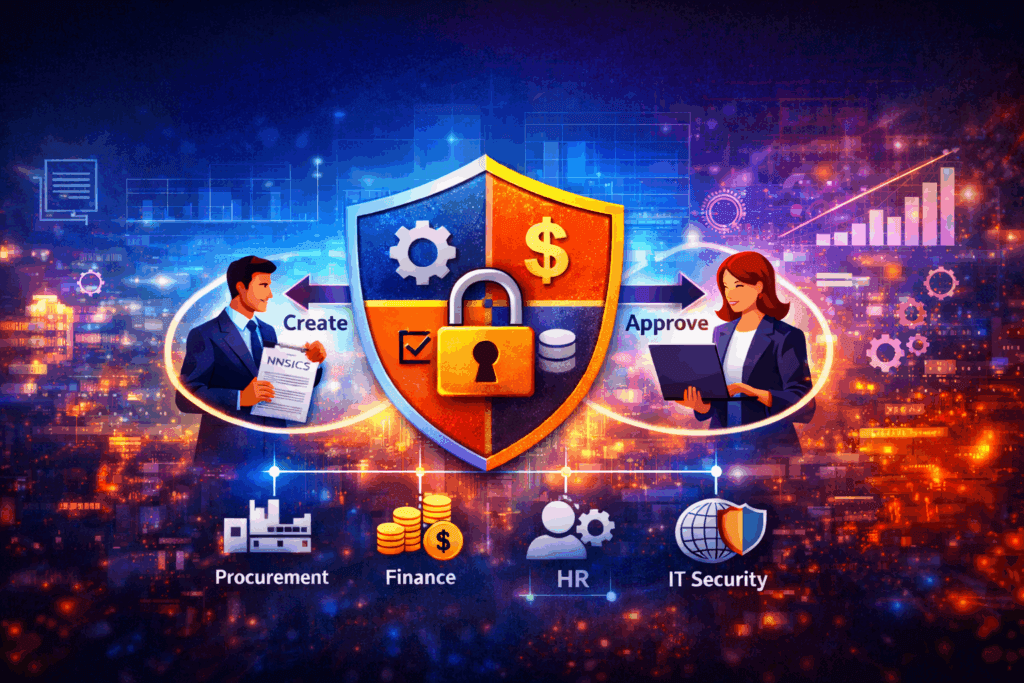
Segregation of Duties: The Most Critical and Complex Control in Modern ERP
In today’s digital-first enterprises, ERP systems sit at the core of business operations, supporting finance, procurement, HR, supply chain, and mission-critical decision-making. While these platforms enable scale and efficiency, they also introduce a significant risk when access is not governed correctly: conflicting or excessive user privileges. This is where Segregation of Duties (SoD) becomes not just important, but essential. Why…

How ERP Role-Based Access Control Aligns Functional Efficiency and Security?
As enterprises scale and digitize operations, ERP environments become increasingly complex, supporting multiple departments, geographies, partners, integrations, and automation. While this complexity enables growth, it also introduces significant access and security risk. The challenge for modern organizations is clear: how do you maintain operational efficiency without compromising security? The answer lies in a well-designed ERP role-based access control (RBAC) tool. Understanding…

Identity Governance for ERP Isn’t Complete Without Segregation of Duties
As enterprises continue to modernize their ERP environments, identity has become the new security perimeter. Users, roles, service accounts, bots, and third-party integrations now access critical ERP functions across finance, HR, procurement, and supply chain operations. While many organizations invest heavily in access controls and role management, identity governance for ERP remains incomplete without one foundational control: Segregation of Duties…